


Bubble Associations: Word Game
4.824.00 Reviews
App Specs
- Version
- 1.07.00
- Updated On
- License
- Free
- Downloads
- 10,000+
- Developer
- NewPubCo
- Categories
- Word
- Platform
- Android
Screenshots
 Analysis by AppCompare
I spent time with Bubble Associations: Word Game as a light word puzzle, and my first impression was that it aims for a very approachable kind of mental workout. The idea is simple: you work with word bubbles, connect related ideas, and gradually reveal categories. That makes it easier to pick up than a traditional crossword, while still asking you to notice relationships between words rather than simply recall definitions.
What makes this game interesting is the balance between recognition and deduction. You may know every word on the screen, yet still need to decide which ones belong together and which apparent connection is a distraction. I found that this gives each short session a useful little pause for thought. It is not a demanding vocabulary course, but it can encourage flexible thinking when I want something more active than scrolling and less intense than a competitive word game.
How the word-bubble format feels in everyday play
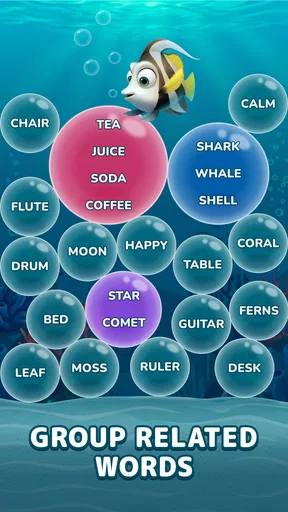
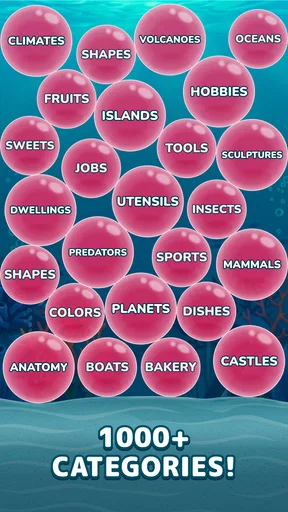
The central interaction is built around merging word bubbles to uncover categories. That structure gives the game a visual identity without making the basic task difficult to understand. I could imagine opening it while waiting for an appointment, taking a short break from work, or settling down in the evening when I wanted a puzzle that did not require a long commitment.
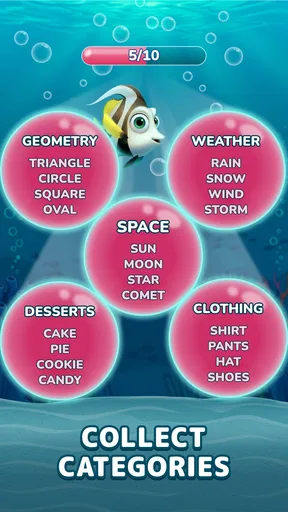
The category element is important because it changes the way I approach the board. In a normal word search, I look for spelling patterns or hidden sequences. In a crossword, I work from clues toward exact answers. Here, I look for meaning, association, and grouping. That difference is the main reason to choose this game over more familiar word titles. It rewards the player who enjoys asking, “What do these ideas have in common?” rather than only, “What word fits this space?”
I also like that the concept can suit different levels of concentration. When I am tired, I can begin with the most obvious relationships and let the remaining bubbles guide me. When I am more alert, I can question my first instinct and search for a more precise category. That makes the format flexible, although the experience will naturally depend on how well the individual puzzles match your vocabulary and way of making connections.
NewPubCo is the developer behind the game. Its current version is 1.07.00, and the minimum operating system is Android 7.1, so it is positioned to work on a broad range of Android devices. The age classification is Everyone, which fits the clean, general-audience nature of a word puzzle. I would still treat the age label as a statement about suitability rather than a promise that every puzzle will feel equally easy for every player.
What I found useful beyond the basic premise
One practical technique is to avoid forcing a category too early. If three bubbles appear to fit together, I first check whether the fourth word changes the meaning of the group. This matters because association puzzles often tempt me into accepting the first plausible pattern. Holding back that final decision can prevent a chain of guesses from sending the whole board in the wrong direction.
Worth Reading Before You Choose

Flipboard Shows What News Apps Must Do Beyond the Feed

Switching to Android Auto Means Rethinking Your Driving Routine

Google Calendar Makes a Crowded Week Easier to Manage

Ludo King Makes the Most of the Minutes Between Plans

Baby Panda World Brings Quick Play to Modern Phones, but Its Game Library Feels Busy

ESPN’s Live Game View Makes Following Close Games Easier
A second useful habit is to separate literal links from contextual links. A word may connect to another because they are commonly used together, while a different pair may relate through a broader topic. Treating both kinds of relationship as possible makes the game less frustrating. It also turns a difficult board into a small exercise in changing perspective rather than repeatedly tapping at random.
I found that the game is most enjoyable when I treat mistakes as information. A failed grouping can show which words do not belong together, narrowing the possibilities for the next attempt. Players who dislike trial and error may find that process irritating, but players who enjoy gradually reducing uncertainty will probably appreciate it. The best way to play is to make deliberate choices, not rush through every bubble simply because the interface feels casual.
Another non-obvious strength is its suitability for shared solving. I can see two people looking at the same set of words and explaining why they see a connection. That is different from taking turns in a fast word duel: the conversation is about reasoning, language, and interpretation. It could work well as a relaxed family activity, provided everyone is comfortable with the fact that one person may recognize a category faster than another.
Free access and the purchase question
The game is free to download, which makes trying the core idea a low-commitment decision. That matters here because association puzzles are personal. Some players immediately enjoy grouping words by meaning, while others prefer anagrams, clues, or timed challenges. Free access lets you discover whether the bubble format suits you before spending anything.
There are in-app purchases ranging from $1.99 to $99.99 per item. I would not treat the presence of those purchases as a reason to avoid the game automatically, but I would pay attention to what the store presents during play before deciding whether any optional purchase is worthwhile. The verified price information establishes free entry and paid items, not the exact contents or long-term value of each purchase, so my recommendation is to judge an offer by the amount of play it adds rather than by the headline price alone.
This distinction is especially important for a puzzle game. Free access can already provide enough value for occasional players who want a few mental breaks. A paid item may make more sense for someone who plays regularly and wants to continue without interruption, but only if the purchase clearly supports that person’s habits. I would avoid buying simply because a difficult puzzle creates pressure; a challenge is part of the game, and spending should feel like a considered choice rather than a solution to temporary frustration.
For families, I would also make the purchase decision together with whoever manages the device. The Everyone rating makes the game broadly suitable by age, but the existence of in-app purchases means the practical question is not only whether children can play it. It is also whether purchase controls and expectations are clear in your household. That is ordinary good practice for any free-to-start mobile game.
Where the game delivers real value
The strongest value comes from the kind of attention it asks for. I am not just matching identical words or filling in obvious blanks. I am comparing meanings, considering context, and testing whether a category is broad enough or too broad. That can make a short session feel more satisfying than a purely reflex-based mobile activity.
It is also a good fit for fragmented time. A realistic use case would be opening it during a ten-minute lunch break, solving a few associations, and putting the phone away without needing to remember a complicated storyline or manage a long session. The game’s premise supports that kind of stop-and-start use because the mental task is self-contained. For me, that is more valuable than a game that demands a large uninterrupted block of attention.
The audience response is encouraging: the game has a 4.8 average from around 330 ratings, with 26 written reviews. It has also passed 10 thousand installs. Those figures do not guarantee that every player will enjoy the same puzzles I do, but they suggest that the concept has found a receptive audience. I read that as a useful signal for anyone wondering whether this is an obscure experiment or a word game that people are actively trying.
Compared with crosswords, this is less dependent on clue-solving conventions and more dependent on semantic grouping. Compared with anagrams, it places less emphasis on spelling manipulation. Compared with word searches, it asks for interpretation rather than visual scanning. Those differences make the choice fairly clear: I would pick this when I want language-based reasoning without the formal structure of a crossword grid.
It may also be preferable to a timed word game for players who dislike pressure. The category approach naturally encourages reflection, and the experience is better when I give myself time to inspect the relationships. On the other hand, someone who wants speed, competition, or a visible performance challenge may find it too quiet. The absence of that intensity is a benefit for me, but a limitation for another kind of player.
Tradeoffs that may affect your enjoyment
The same simplicity that makes the game accessible can limit its appeal over a long period. If you prefer elaborate progression, story, or a large range of puzzle mechanics, merging word bubbles may eventually feel narrow. The concept has a clear identity, but that also means it cannot be all things at once. I would see it as a focused word activity rather than a complete replacement for every other puzzle game on a phone.
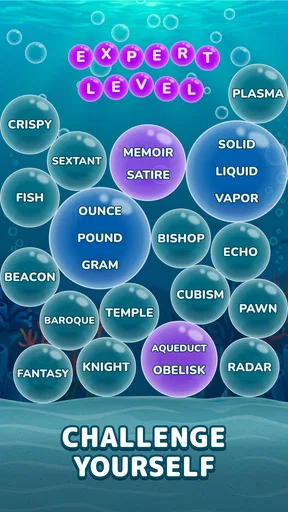
Difficulty can also feel subjective. A category that seems obvious to one player may be invisible to another because people organize knowledge differently. That is not necessarily a design flaw, but it can create moments where the game feels arbitrary instead of clever. My advice is to pause and reconsider the relationship between the words before assuming the puzzle is unfair. If you regularly dislike broad or indirect associations, this format may remain more annoying than rewarding.
The purchase range is another tradeoff. Free entry is attractive, but paid items mean that the full value depends on how you respond to optional spending. Since the exact contents of individual items are not part of the basic product facts, I would not promise that purchasing will transform the experience. I would keep playing for a while, decide whether the free experience already meets my needs, and only then consider paying for something that has a clearly explained benefit.
There is also a difference between mental exercise and measurable training. The game can make me think about language and categories, but I would not use it as proof of improved memory, intelligence, or academic performance. Its value is immediate and practical: it gives me a structured way to focus for a few minutes. That is enough to recommend it, as long as expectations stay realistic.
Who should try it, and who should look elsewhere
I would recommend it to casual puzzle players, people who enjoy word relationships, and anyone looking for a calm activity that can fit around a busy day. It is particularly suitable if you like solving through discussion and interpretation rather than racing against a clock. The free starting point also makes it sensible for curious players who are unsure whether association puzzles are their style.
It could be a good choice for a parent looking for an age-rated word game to explore with a child, although I would let the child’s reading level and vocabulary guide the decision rather than relying on the Everyone label alone. It can also suit older players who want a simple interface and a reason to examine words from different angles. The shared-solving possibility gives it a social use that is easy to overlook.
I would skip it if your main goal is competitive ranking, rapid tapping, or a deep campaign. I would also choose a crossword or a more clue-driven game if you prefer every answer to be anchored by a precise definition. Players who become frustrated by ambiguous connections should try the free version first and pay attention to how often the category logic feels satisfying rather than forced.
For someone studying a language, it may offer exposure to relationships between familiar words, but I would not mistake it for a structured language-learning course. It does not replace lessons, vocabulary review, or pronunciation practice. Its better role is as a supplementary mental activity for a learner who already understands enough of the words to reason about their connections.
My verdict on downloading and spending
My overall view is positive because the game knows what it wants to be. It offers a focused association puzzle built around word bubbles, and that is enough to create a pleasant alternative to crosswords, anagrams, and word searches. I especially value the way it fits short breaks while still giving me something to reason through.
I would download it if I wanted a free word game with a calm pace and a category-based twist. I would play first without assuming that an in-app purchase is necessary, then decide whether the available paid option genuinely adds value for my routine. The free entry makes that approach easy, while the purchase range is a reminder to stay deliberate rather than spending impulsively.
In the end, Bubble Associations: Word Game is best for people who enjoy discovering connections and are comfortable with the occasional puzzle that requires a change of perspective. It is not the right choice for everyone, and its focused design may feel limited beside larger puzzle collections. For me, though, it succeeds as a compact, approachable way to give my attention a useful direction for a few minutes at a time.
Pros
- Simple rules make it easy to start playing immediately.
- Short rounds are ideal for quick breaks or casual sessions.
- Word associations help exercise memory and flexible thinking.
- Clean visuals keep attention focused on the puzzle.
- Progressive challenges can keep regular players engaged.
Cons
- Some puzzles may accept only one expected association.
- Difficulty can feel uneven between consecutive levels.
- Repeated word themes may reduce variety over time.
- Hints or extra attempts may be limited during harder rounds.
- Offline availability may vary depending on the game version.
FAQs for Bubble Associations: Word Game
What is Bubble Associations: Word Game?
Bubble Associations: Word Game is a casual word puzzle in which you connect related words and discover the association between them. Each level presents a group of bubbles containing words, and your task is to identify the correct relationship or sequence. It is designed for short, relaxing sessions while still testing vocabulary, logic, and pattern-recognition skills.
How do you play Bubble Associations: Word Game?
Gameplay is generally easy to understand: read the words shown in the bubbles, look for a common theme or connection, and select or arrange the matching options. Some puzzles may require careful comparison because several words can appear related at first. Progress depends on recognizing the strongest association, so taking a moment to consider the whole group is often more useful than guessing quickly.
Is Bubble Associations: Word Game suitable for beginners and children?
The game is accessible to beginners because its basic controls and word-association concept are straightforward. However, difficulty can vary depending on vocabulary, spelling familiarity, and cultural references used in individual puzzles. Younger players may enjoy it as a language and reasoning exercise, but parents should check the age rating and review the content if the game is being installed for a child.
Does Bubble Associations: Word Game require an internet connection?
Whether an internet connection is necessary can depend on the version installed and the features currently enabled by the developer. Basic puzzle progress may work offline in some releases, while advertisements, analytics, cloud synchronization, updates, or optional rewards may require connectivity. If offline play is important to you, test a few levels after installation and check the app’s store description for the latest requirements.
Is Bubble Associations: Word Game free to download, and does it include ads or purchases?
Bubble Associations: Word Game may be available as a free download, but free access commonly includes advertising and optional in-app purchases. Ads can appear between levels or when using hints, while purchases may offer additional clues, remove advertisements, or provide other conveniences. Before downloading, review the current Google Play or App Store listing so you understand the pricing, permissions, and available purchase options.


